
The Little Things That Make a Big Difference: Small Changes, Better Fishing
We have all been there. You arrive at the water full of optimism, set up your tackle, choose what looks like the perfect bait and settle into a session expecting the fish to oblige. An hour passes, then another, and the results simply do not match your expectations. Meanwhile, someone a short distance away seems to be catching regularly.
It is tempting to blame the weather, the venue or the fish themselves. Perhaps we start thinking about changing rods, reels, rigs or even making a completely different approach. But before spending money on new tackle or abandoning a promising swim, it is worth remembering one important lesson: sometimes the smallest adjustments can make the biggest difference.
Successful angling is often about observation, patience and the willingness to change one thing at a time.
Start With the Hook
The hook is one of the smallest pieces of equipment we use, yet it can have a significant influence on our results.
If you are missing bites, struggling to hook fish or finding that your bait looks unnatural, consider whether your hook size is appropriate. A large hook may be unnecessarily conspicuous when fishing with small baits, while a hook that is too small may not suit a larger bait or the fish you are targeting.
Match your hook to the bait, the species and the conditions. A smaller hook can sometimes help present a delicate bait more naturally, but smaller is not automatically better. The hook must still be strong enough for the fish and the tackle being used.
It is equally important to check that your hook is sharp, undamaged and securely attached. A blunt point or poorly tied knot can undo all the good work that went into choosing the right bait and finding the fish.
Feed Less, Catch More?
When fish are not feeding confidently, it is easy to assume that adding more groundbait or loose feed will encourage them to start. Sometimes it does, but sometimes it simply gives them more food to eat without taking your hookbait.
Try reducing the amount you introduce, particularly when bites are slow or the fish appear wary. A small, accurately placed quantity of feed may be enough to attract attention without overfeeding the swim.
On a stillwater, consider introducing a little feed and watching how the session develops before adding more. On a river, the flow will influence how loose feed travels, so think carefully about where it will settle and where the fish are likely to intercept it.
There is no single rule that works everywhere. The important thing is to treat feeding as something you control, rather than something you do automatically throughout the session.
Are You Fishing at the Right Depth?
Depth is another small adjustment that can transform a session.
When float fishing, a change of just a few inches can determine whether your bait is presented naturally near the bottom, suspended above it or sitting in an unproductive position. If you are getting indications without hooking fish, or seeing signs of fish activity without bites, experiment with the depth.
On rivers, changes in flow, the shape of the riverbed and the position of fish can all influence where your bait should be presented. In stillwaters, fish may move between the margins, the bottom and higher in the water depending on temperature, light, natural food and other conditions.
If you are fishing on the bottom, check that your rig is behaving as intended. Is your hookbait presented clearly? Is your line affecting the presentation? Could a slightly different length of hooklink or position of the bait improve matters?
Rather than making several changes at once, adjust one element and give it a fair chance to work.
Give Your Bait a Second Look
Sometimes the answer is as simple as changing the bait.
If one bait has produced little interest, try a different size, colour, texture or flavour where appropriate. A smaller bait may be more appealing when fish are feeding cautiously, while a different presentation may help your hookbait stand out from the surrounding feed.
Natural baits can be particularly effective when they resemble the food fish are already finding. Equally, an alternative bait may be worth trying when the fish appear uninterested in your first choice.
Before changing everything, consider whether the problem is actually the bait. You might be fishing at the wrong depth, feeding too heavily or simply placing your bait away from the fish. Changing bait can help, but it is not a substitute for observing what is happening around you.
Check the Details You Cannot See
Knots, line and terminal tackle deserve regular attention, even when everything appears to be working perfectly.
Line can become damaged through contact with rocks, gravel, vegetation or other underwater obstacles. Knots may weaken if they have been tied poorly or pulled tight incorrectly. Hooks can become blunt or damaged after contact with hard surfaces.
Take a moment to inspect your line, check your knots and examine your hook before fishing and after landing a fish or becoming snagged. Replace anything that looks doubtful. It is a small investment of time that could prevent the disappointment of losing a fish because of a simple equipment failure.
Make sure your tackle is suitable for the species you are targeting and the conditions in which you are fishing. Small adjustments should improve your presentation without compromising the safe landing and handling of fish.
Learn to Read the Water
I say this all the time but it bears repetition. Perhaps the most valuable adjustment is not to your tackle at all, but to your approach.
Look for signs of fish activity, changes in the water, likely feeding areas and features that might provide shelter or natural food. On a river, observe the flow, the seams between faster and slower water, deeper runs and areas of cover. On a stillwater, pay attention to margins, weed beds, changes in depth and any signs of fish moving or feeding.
Conditions can change during a session. A swim that was productive early in the morning may become less appealing as the light, temperature or wind changes. Being prepared to alter your position, casting distance or presentation can be more effective than persisting with the same method simply because it worked last time.
Keep an open mind, and do not be afraid to learn from a quiet session. Every change you try gives you another opportunity to understand what the fish are responding to.
Small Changes, Better Angling
Good angling is rarely about making the most dramatic change. More often, it is about noticing the details and making sensible decisions.
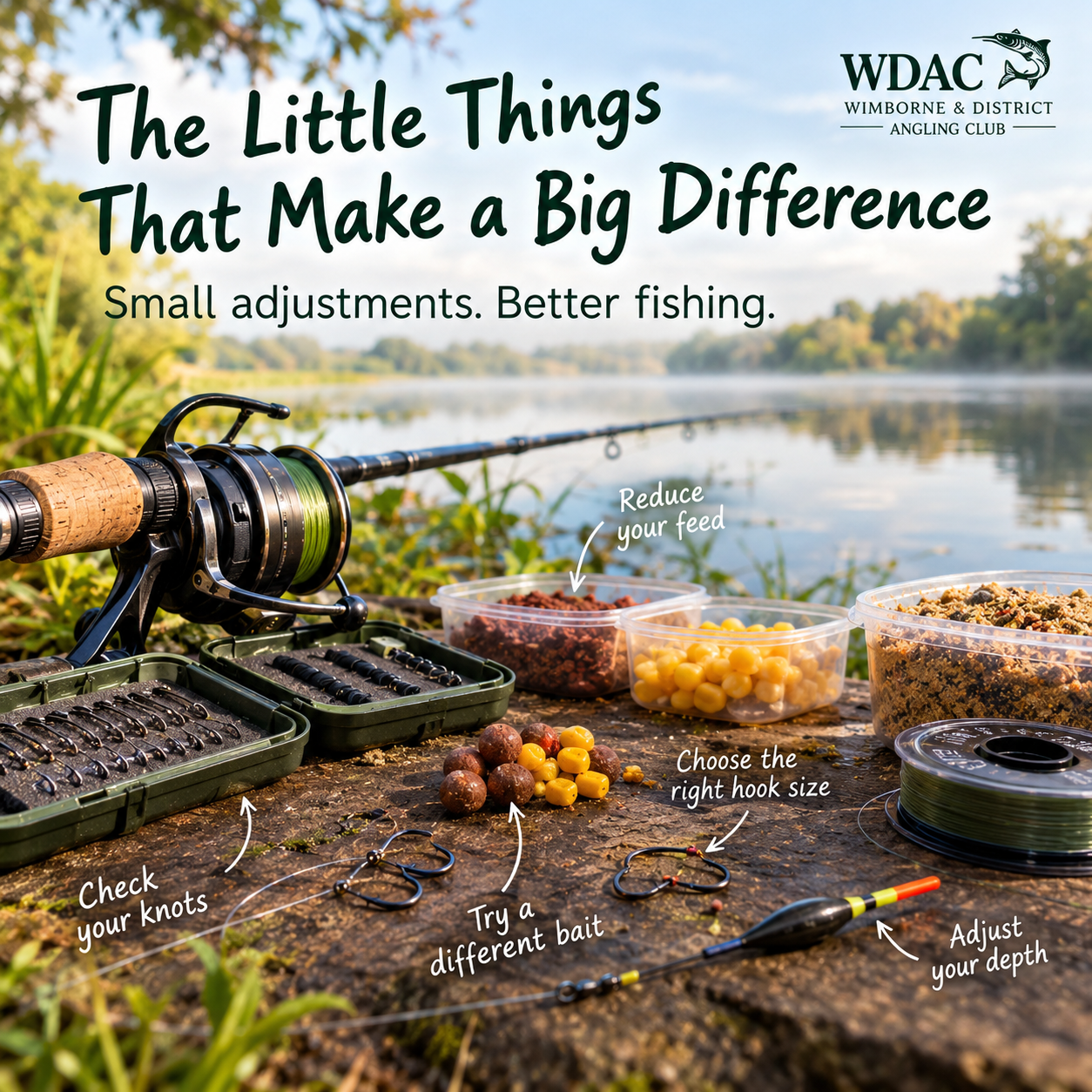
Before replacing your tackle or changing your entire approach, check your hook, inspect your knots, review your feeding, experiment with depth and consider whether your bait is being presented naturally. Make one change at a time, observe the result and build your understanding of the water.
At Wimborne and District Angling Club, we want our members to enjoy their fishing, develop their skills and get the most from every visit to our waters. Remember, a quiet session is not necessarily a wasted one. Sometimes the most valuable catch is the lesson that helps you succeed next time.
The next time the fish are not playing ball, think small.