
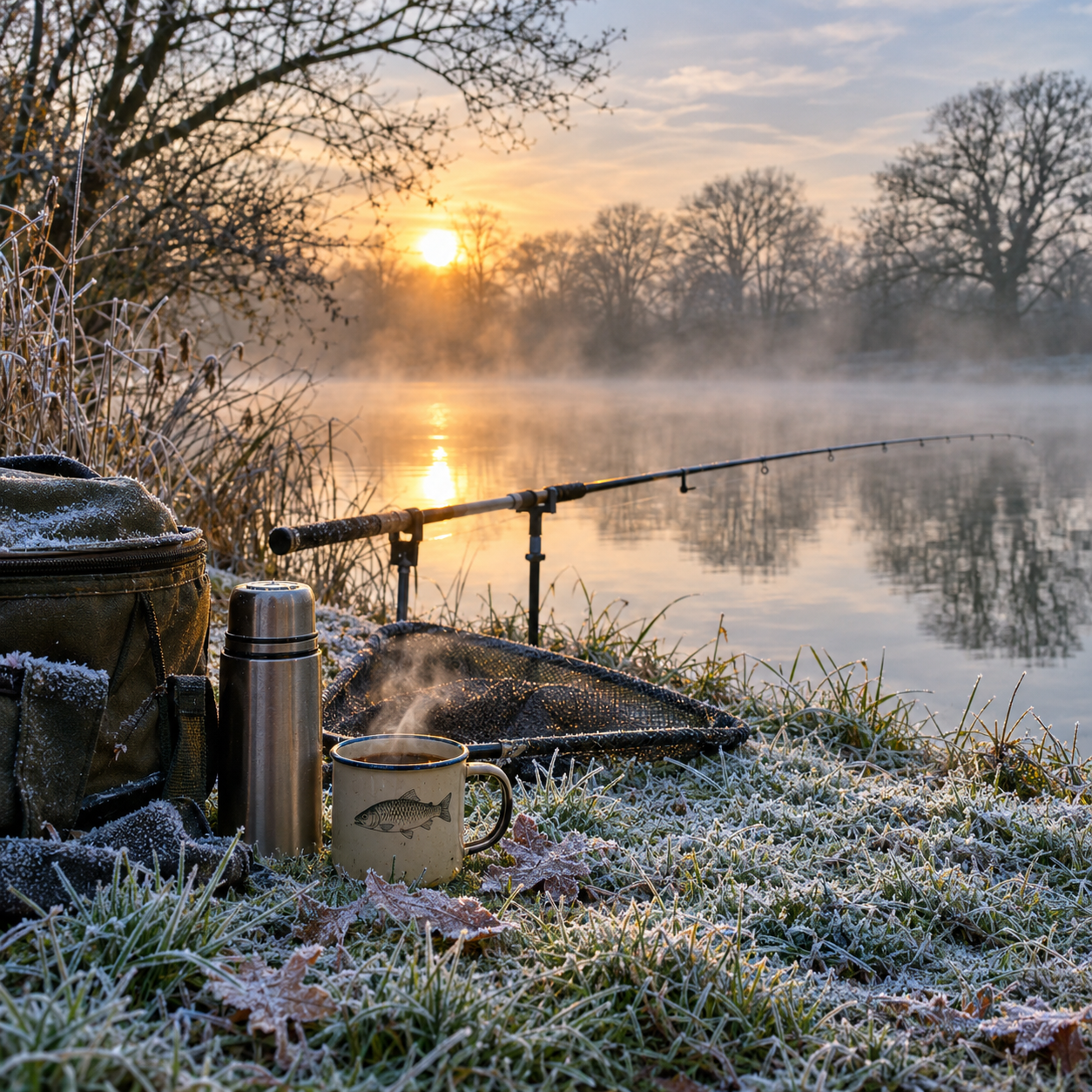
There are two types of anglers in winter. Those who look out of the window, see the frost on the lawn, and decide that fishing can wait until spring. And those who look at exactly the same frost and think, “That looks promising!” Whether the second group is dedicated, optimistic or a little unhinged is open to debate. After all, there is something rather peculiar about voluntarily leaving a warm house, scraping ice off the car, and spending several hours sitting beside a lake or river in temperatures better suited to storing frozen peas. And yet, for those of us who venture out, winter fishing can be some of the most rewarding angling of the year. So, are we mad? Possibly. Is winter fishing bad? Not necessarily. Can it be surprisingly good? Absolutely!
The Great Winter Mystery
One of the first things winter teaches us is that fish don't read the rulebook. We're told that cold water slows their metabolism, reduces their appetite and makes them less inclined to move about. All perfectly sound advice. Unfortunately, nobody appears to have explained this to the fish. You can spend three hours watching a motionless float, convinced that every fish in the lake has entered hibernation, only for the next half-hour to produce more action than an entire summer afternoon.
Why? Water temperature, atmospheric conditions, light levels, dissolved oxygen and natural food availability all influence fish behaviour. Even a small rise in temperature can encourage feeding, particularly after a prolonged cold spell. And while fish generally require less food during winter, they don't stop eating altogether. The trick is discovering when, where and how they want to feed. Simple really. Well, apart from the discovering bit.
Location, Location, Location
In summer, finding fish can sometimes be relatively straightforward. There may be movement on the surface, bubbles amongst the lilies or obvious signs of feeding. Winter fish tend to be rather less accommodating. Many species become less active and may gather in particular areas, sometimes in deeper or more sheltered water where conditions are relatively stable. But here's the important bit: deeper isn't automatically better. On a bright, relatively mild winter afternoon, shallow water receiving plenty of sunlight may warm slightly and attract feeding fish. Similarly, sheltered bays, underwater features and areas offering protection from strong currents can be worth investigating.
On rivers, look for slower glides, deeper pools, creases and areas where fish can hold position without constantly battling the flow. The key is observation. Rather than automatically heading for your favourite summer swim, spend a few minutes looking at the water and considering where the fish might be comfortable. After all, there's little point presenting the perfect bait if the nearest fish is fifty yards away.
A Little of What You Fancy
Winter feeding requires a slightly different approach. During warmer months, a generous helping of groundbait, pellets or loose feed can encourage fish to settle and feed confidently. In winter, however, overfeeding can be the quickest way to turn a promising swim into a very quiet one. A few maggots, a small piece of worm, a modest helping of finely prepared groundbait or a carefully presented single hookbait may be all that's needed. Think quality rather than quantity.
Small, regular offerings can help maintain interest without filling the fish up. But even this depends on the species, venue and conditions. Sometimes the most effective feeding strategy is to introduce very little at all. It's rather like offering someone a biscuit after Christmas dinner. They might manage one, but presenting an entire packet is unlikely to improve their appetite. And don't forget presentation. Cold-water bites can be delicate, so balanced tackle, suitable hook sizes and sensitive float or ledger arrangements can make a real difference. Not that every winter bite is shy. Occasionally a fish will pull the rod round with enough enthusiasm to make you spill your tea. Assuming, of course, that your tea hasn't already frozen.
The Importance of Timing
Winter fishing isn't always about spending every available hour beside the water. In fact, a carefully timed two-hour session can sometimes outperform an entire day. On many stillwaters, late morning and early afternoon can be productive, particularly when the sun has had an opportunity to warm the shallows. On rivers, feeding patterns may be different, and certain species can become more active towards dusk.
There are no guarantees, but keeping a record of successful times, weather conditions and water temperatures can reveal useful patterns. A thermometer can be a surprisingly valuable addition to the tackle bag. And perhaps the most useful lesson is that winter fish often feed in short spells. You might experience hours of inactivity followed by a sudden burst of bites. Which explains why the moment you decide to pack away the landing net is frequently the moment your float disappears. Fish, it seems, have an excellent sense of comic timing.
The Frozen Finger Problem
Of course, winter fishing brings challenges that have absolutely nothing to do with catching fish. There's the delicate business of threading a maggot onto a hook when your fingers have lost all sensation. The mysterious disappearance of your landing-net handle beneath a layer of frost. The flask that promised six hours of piping-hot tea but delivers something resembling lukewarm dishwater after ninety minutes. And the inevitable discovery that the one item of clothing you really needed is still hanging on the back of the kitchen door.
Preparation makes an enormous difference. Warm, layered clothing, waterproof footwear, a decent hat and gloves that allow you to handle tackle safely are essentials rather than luxuries. A spare pair of dry socks is never a bad idea either. Remember that standing or sitting still for long periods allows the cold to creep in surprisingly quickly. Keep moving occasionally, eat regularly and make sure you have enough warm drinks. Above all, don't let enthusiasm override common sense. Icy banks, slippery platforms, swollen rivers and freezing conditions present genuine hazards. Check the weather, assess the banks carefully and never take unnecessary risks around water. No fish is worth an unexpected winter swim. Especially when you haven't brought a towel.
Why Bother?
With all these difficulties, it's reasonable to ask why anyone would choose to fish through the winter. The answer is that winter offers something rather special. Our WDAC waters take on a completely different character during the colder months. The banks are quieter. The trees stand bare against pale winter skies. Mist hangs above the surface, and the usual background noise of summer seems to disappear. Wildlife becomes easier to observe. A kingfisher flashing along the bank, a heron standing motionless in the shallows or the sudden appearance of an otter can turn an otherwise uneventful session into something memorable.
And there's a particular satisfaction in catching a fish when conditions are difficult. A modest roach on a bitterly cold morning can feel every bit as rewarding as a much larger fish caught during the summer. Perhaps more so. Because winter fishing demands thought, patience, observation and a willingness to adapt. It reminds us that successful angling isn't simply about casting out and waiting. It's about understanding the water and the creatures that live in it.
The Unexpected Bonus
There's another advantage to winter fishing that often goes unmentioned. You get to know your waters. With vegetation reduced and fewer anglers on the banks, features that remain hidden during summer become easier to identify. Submerged branches, changes in depth, marginal shelves and areas of potential fish-holding cover may become more apparent. A quiet winter session can therefore be as much about gathering information as catching fish.
Take note of what you discover. That unremarkable-looking swim in January might become your favourite spot in June. And if the fish refuse to cooperate, at least you've learned something useful. Which is considerably more satisfying than simply blaming the weather. Although blaming the weather remains a perfectly respectable angling tradition.
So, Mad, Bad or Surprisingly Good?
Probably a little of all three. You may question your sanity while defrosting your car windscreen at seven in the morning. You may regret your decision when the wind changes direction and finds the one gap between your scarf and collar. And you may spend several hours wondering whether the fish have all emigrated to warmer waters. But then something happens. A float dips. A quivertip trembles. The rod comes alive, and suddenly the cold, the waiting and the rapidly cooling tea are forgotten. For a few wonderful moments, there's nowhere else you'd rather be.
That's the magic of winter fishing. It doesn't always reward us with numbers of fish, but it can reward us with some of our most memorable experiences. So, the next time you look out of the window and see frost sparkling on the grass, don't automatically put the kettle on and settle down in front of the television. Put the kettle on, certainly. But fill a flask, find your warmest socks and consider giving winter fishing another chance. You might be pleasantly surprised. And if anyone questions your sanity, just tell them you're conducting important research into cold-water fish behaviour.
It sounds so much better than admitting you've spent four hours freezing beside a lake for two roach and a cold sausage roll.
Have you enjoyed a memorable winter session on one of our WDAC waters? Perhaps you've had an unexpected catch in freezing conditions, or discovered a winter tactic that really works. We'd love to hear your experiences, tips and tales from the bank. After all, the only thing better than a good winter fishing story is having someone else confirm that you're not the only one mad enough to be out there! GW